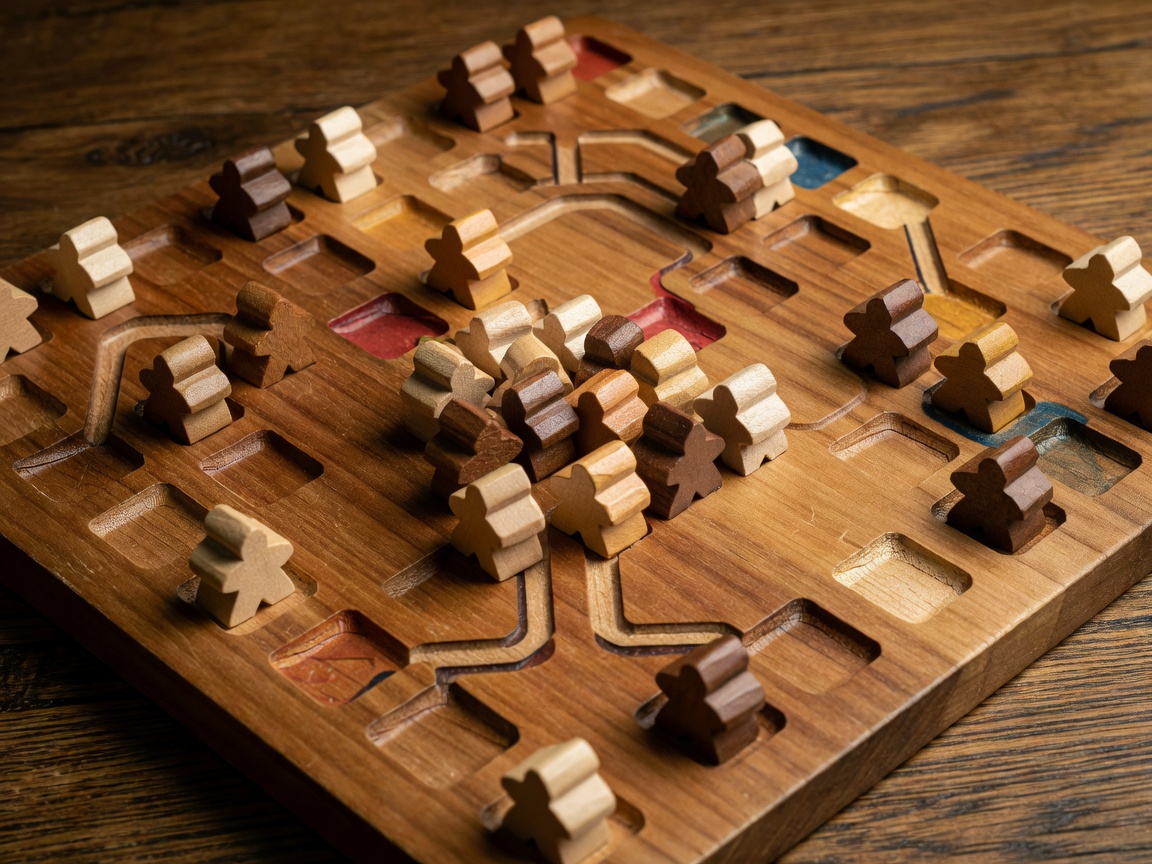
At its core, worker placement turns opportunity cost into something physical. You are not only deciding what you want to do, but also when you must claim it and what you are willing to leave open. A worker on the board is both an action taken and a statement of priority. That is why the mechanism remains so readable: players can inspect the table and understand which resources, conversions or privileges are disappearing.
The cleanest early explanation still comes from Caylus. Its structure is severe. Spaces matter because access is tight, order matters because strong actions can vanish, and the possibility of disrupting the sequence matters because turn order is itself a resource. The lesson is not that every worker placement game should be harsh. It is that the mechanism works best when a claimed space changes everyone else’s plan.
Agricola makes the same point with a different emotional texture. Its tension comes from accumulated spaces and domestic pressure. You are feeding a household, growing rooms, acquiring animals and trying not to fall behind on basic needs. Blocking here does not feel abstract. It feels urgent. If someone takes wood before you do, it is not merely a denied efficiency. It can alter the timing of building, fencing and expansion across several rounds. That connection between immediate denial and medium-term reshaping is one reason Agricola is such a clear teaching text for the mechanism.
Lords of Waterdeep is useful because it strips away some of that severity. It keeps placement and blocking, but makes the action menu and reward loops easier to parse. If someone wants to understand worker placement without first wrestling with subsistence pressure, this is one of the more approachable published examples. The trade-off is that the blocking can feel gentler. Spaces matter, but the game usually gives enough ways to recover that the sting is moderated.
Viticulture shows another variation: seasonal structure. Workers are not just allocated to spaces; they are allocated to moments. Summer and winter divide the board and ask players to think in batches. This does something subtle. It turns “can I take this action?” into “can I spare this worker now, knowing I will want flexibility later?” A good worker placement design often lives in exactly that sort of temporal pinch.
What the mechanism does well
Worker placement excels at making interaction legible without requiring combat, negotiation or hidden information. You do not need to attack someone to disrupt them. You only need to arrive first. That matters for groups who want tension without direct destruction. The mechanism also gives designers a reliable way to pace a game. A round ends, workers return, and the table resets just enough for a new contest.
It also scales pressure elegantly through worker count. Fewer workers mean tighter decisions. More workers allow for combo turns and broader plans. Extra-placement effects, such as gaining an additional worker later in the game, feel powerful because they bend the main scarcity. The effect is easy to read because the base limit is so concrete.
Where it can go flat
Not every game with workers on spaces gets the benefit. If the spaces are plentiful, the alternatives interchangeable and the penalties for missing a space minor, the mechanism becomes procedural rather than dramatic. Players may still enjoy building something efficient, but the identity of worker placement weakens.
Another risk is obvious sequencing. If a design has one clearly correct opening, then a mandatory follow-up and a narrow best route after that, placing workers becomes bookkeeping with queueing. Good worker placement leaves room for tactical adaptation. It needs enough friction that plans can collide, but enough elasticity that a collision produces a new line rather than a dead turn.
Shortcut test: if removing the rule that spaces can be blocked would leave the game mostly intact, worker placement is probably not the main engine of the design.
How to identify a strong published example
- Look for visible scarcity. The desirable actions should not all remain open.
- Check whether timing matters. Turn order, round order or seasonal order should alter value.
- Watch for alternative routes. A blocked plan should hurt, but not end the round.
- See whether worker count changes the feel. If an extra worker feels dramatic, the core limit is doing real work.
If someone asks for the clearest sequence of examples, Lords of Waterdeep is the easy doorway, Viticulture shows temporal allocation well, Agricola shows domestic pressure and cumulative denial, and Caylus shows the underlying bones in stark form. None of them is a universal model. Together, though, they explain why the mechanism has lasted: it translates scarcity into something you can point at with a finger.