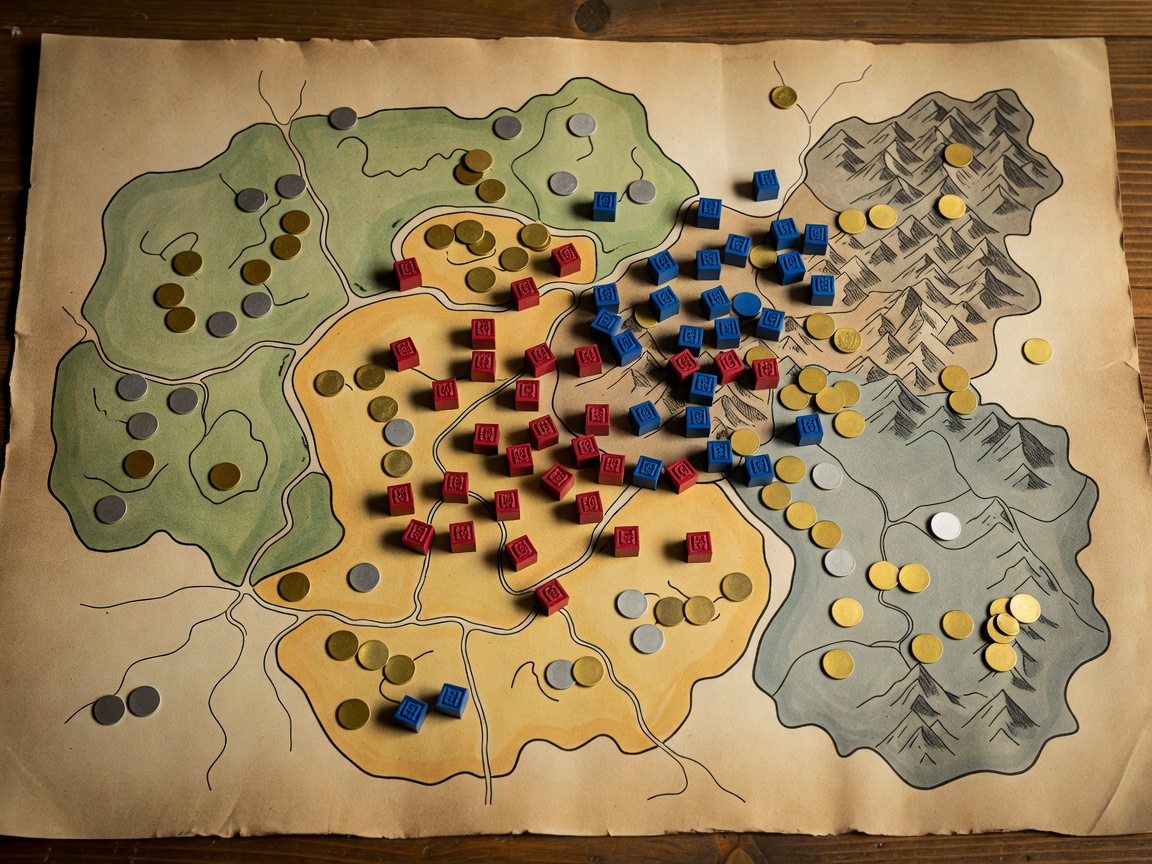
Area control, sometimes called area majority, asks players to compete over spaces on a map or network because occupancy, strength or comparative presence produces value. The essential decision is not “can I move here?” but “why does this space matter now, and what am I giving up elsewhere?” A territory mechanism without meaningful comparative pressure can feel decorative. A strong area control design makes every region part of a live argument.
Risk is the well-known public reference, but it is not the clearest teacher of modern area control. Its identity is bound to expansion, dice-driven battle and continent bonuses. Those ingredients make map ownership legible, yet they also encourage momentum swings and elimination pressure. Useful historically, yes. Complete as a map-control explainer, not really.
El Grande is much cleaner. It turns regional majority into the centre of the game and handles timing with unusual precision. Power cards affect initiative and action strength. The castillo withholds information until scoring. Presence can be concentrated, spread or disguised. Most importantly, the map is scored repeatedly. That means a region is not valuable once. It is valuable at specific moments, and the worth of investing there depends on whether you can hold, surprise or overtake. Few games show the mechanism’s structure better.
Inis changes the feel by making position tactical and contested through card draft and conditional victory states. You are not only spreading into empty land. You are threatening multiple win conditions, negotiating by posture and reading whether a clash is worth provoking. This gives area control a lighter footprint on the map than sprawling conquest games, while preserving the core idea that placement changes everyone’s calculations.
Root is useful for a different reason: it demonstrates how asymmetry complicates territory. All factions care about the map, but they do not all value space in the same way. The Marquise de Cat wants a production network. The Eyrie Dynasties need stability of decree. The Woodland Alliance wants sympathy and insurgent openings. The Vagabond operates by another logic entirely. Calling Root “area control” is not wrong, but it is incomplete. The map matters because factions translate map pressure into different resource and scoring systems.
Why map pressure works
Area control is excellent at externalising competition. Everyone can see the board state, the borders, the choke points and the vulnerable regions. Decisions become spatially intuitive even when scoring is subtle. It also lets designers attach meaning to geography. A narrow bridge, a rich province, a cluster of connected regions or a distant frontier can create recognisable strategic patterns with very little rules text.
The mechanism also encourages timing over accumulation. Simply being everywhere is often impossible or wasteful. The better question is where strength should be concentrated before a scoring window, a battle, a card play or a victory check. That keeps the map alive. Static ownership is dull. Threatened ownership is usually not.
Where the design can struggle
If combat is too punishing, players may turtle until the late game or dogpile the leader in a predictable way. If combat is too soft, the map may lose edge and become a passive point matrix. The same problem appears with scoring cadence. Score too often and players may feel they cannot build pressure. Score too rarely and early map mistakes can snowball into a long trudge.
Another recurring issue is whether empty territory matters. Some designs make initial expansion routine and reserve tension for border fights. Others, like Inis, keep the map tight enough that every move is political from the beginning. Neither is universally better. The question is whether the map becomes interesting soon enough.
Published examples and what each one clarifies
- Risk shows conquest and reinforcement loops, but also why elimination can overshadow positional play.
- El Grande shows repeated scoring, initiative trade-offs and majorities as pure structure.
- Inis shows positional threat, drafting and flexible victory pressure.
- Root shows how asymmetry changes what control means in practice.
If a game has a map but you could replace the regions with abstract boxes and lose little, the map may be a setting. In strong area control, geography itself is doing design work.
Area control is therefore best understood not as “games with territory” but as games where position is the main currency of pressure. The clearest examples make regions matter for different reasons and at different moments. That is why the mechanism can feel like a military push in one design, a courtly contest in another and a negotiation of threat in a third. The map stays constant. The meaning of being on it does not.