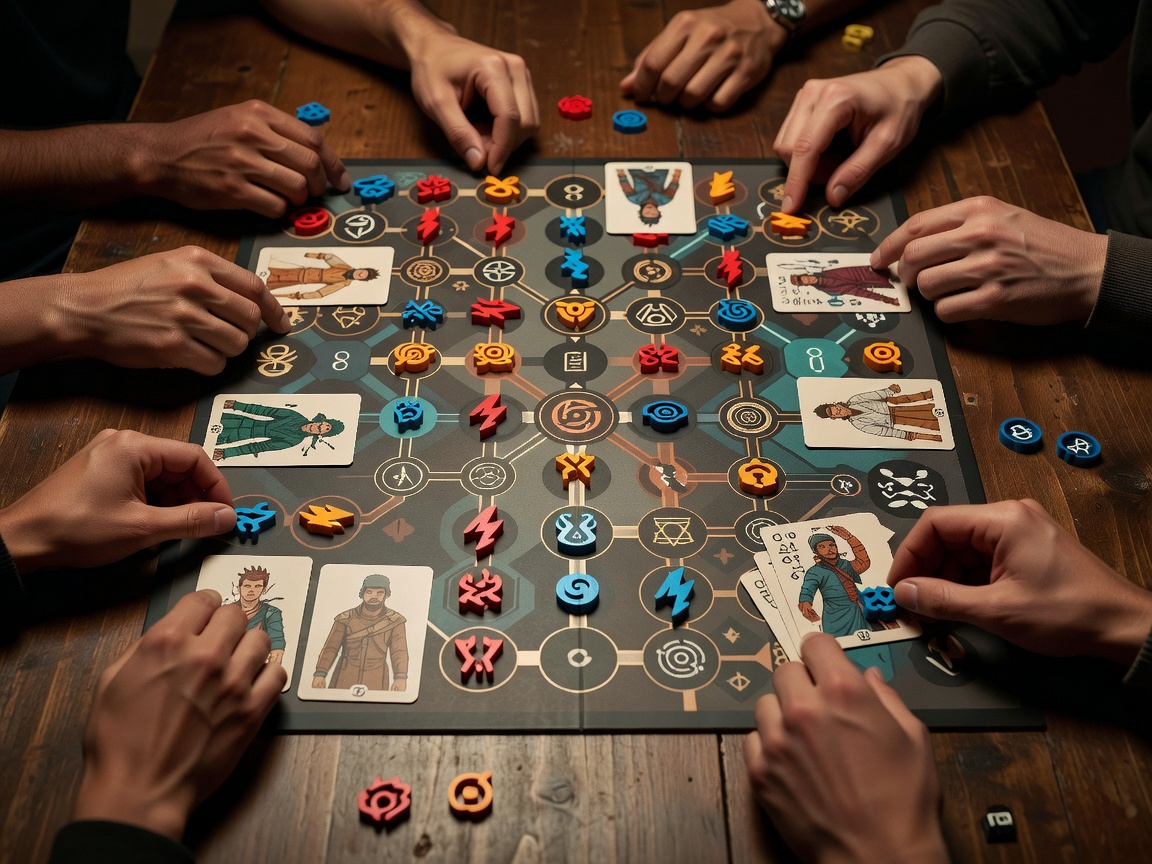
A cooperative game asks the table to solve a system together. That sounds simple enough, but the design challenge is awkward. If all information is open and one line of play is usually best, the most assertive player can take over. If information is fragmented too aggressively, cooperation turns into confusion. The mechanism therefore lives in the space between complete shared control and constrained communication.
Pandemic is still one of the clearest places to start. The infection deck creates escalating pressure, outbreaks turn local mistakes into network problems, and specialist roles give players reasons to value different actions. As a system, it is admirably legible: treat disease, manage cards, build stations, race cures. Its great strength is also the source of its common criticism. Because the board state is open and lines can often be analysed collectively, quarterbacking is a real risk. That does not make Pandemic a poor design. It makes it an honest demonstration of one major cooperative design problem.
Hanabi tackles that problem by limiting communication directly. Players hold their cards facing outward, see everyone else’s hands but not their own, and can only give narrow clues. This one rule transforms the social texture. Cooperation is still central, yet no player has perfect authority because no one possesses perfect information. The game becomes about signalling, inference and timing. It is one of the sharpest published examples of how restricted information can protect cooperation from becoming committee arithmetic.
The Crew goes further into communication constraints through trick-taking. Missions ask players to capture specific cards under limited signalling rules. The design works because trick-taking already has an internal language of lead, follow, voids and tempo. Cooperative structure does not replace that language. It exploits it. The result is a game where teamwork is inseparable from reading implied intention. It is one of the best cases for how an older mechanism can be re-purposed into a co-operative format without losing its identity.
Spirit Island shows the opposite end of the scale: open information, asymmetrical powers and heavy planning density. Spirits defend, push, gather, destroy, generate fear and manipulate presence in highly distinct ways. The game resists domination partly because the decision space is too distributed for one person to run comfortably, and partly because each spirit’s toolkit is specialised enough that its owner has local expertise. This is an important lesson. Hidden information is not the only defence against quarterbacking. Genuine asymmetry and complexity can help too, though they raise the learning curve.
What co-operative design does well
The mechanism is excellent at creating table talk with a common purpose. A strong co-operative game turns discussion itself into part of the play texture. It also lowers some of the emotional cost of failure. Losing together can still sting, but it rarely carries the same personal edge as a direct defeat. That makes the form especially useful for mixed-experience groups, provided the design avoids placing all authority in one player’s hands.
Co-operative structures are also good at modelling systemic pressure. Disease spread in Pandemic, mission constraints in The Crew, information gaps in Hanabi and invader cascades in Spirit Island all create problems that feel larger than any individual move. The team is not merely sharing a score track. It is sharing an emergency.
The recurring fault lines
The first is quarterbacking. If one player can compute an obviously best plan from public information, the others may become operators rather than partners. The second is opacity. If the game hides too much or overloads players with exceptions, collaboration can become vague and unsatisfying. The third is runaway crisis. A co-operative design needs pressure, but if recovery becomes visibly impossible too early, the last stretch can feel ceremonial.
How published examples divide the space
- Pandemic — open planning, role powers and cascading threats.
- Hanabi — strict clue limits and inference as teamwork.
- The Crew — communication discipline inside trick-taking logic.
- Spirit Island — asymmetry and distributed expertise.
Good co-operation is not the absence of tension. It is tension redirected from “which player beats the rest” to “which problem the group can afford to solve first.”
That redirection is why co-operative design remains so interesting. It changes not only the victory condition but the social physics of the table. The cleanest examples show different answers to the same awkward question: how do you let players think together without reducing the whole experience to one person speaking and everyone else nodding grimly at the cardboard?