Worker placement
Why blocking matters, why action spaces create tension, and why Agricola, Caylus, Lords of Waterdeep and Viticulture explain the mechanism in different ways.
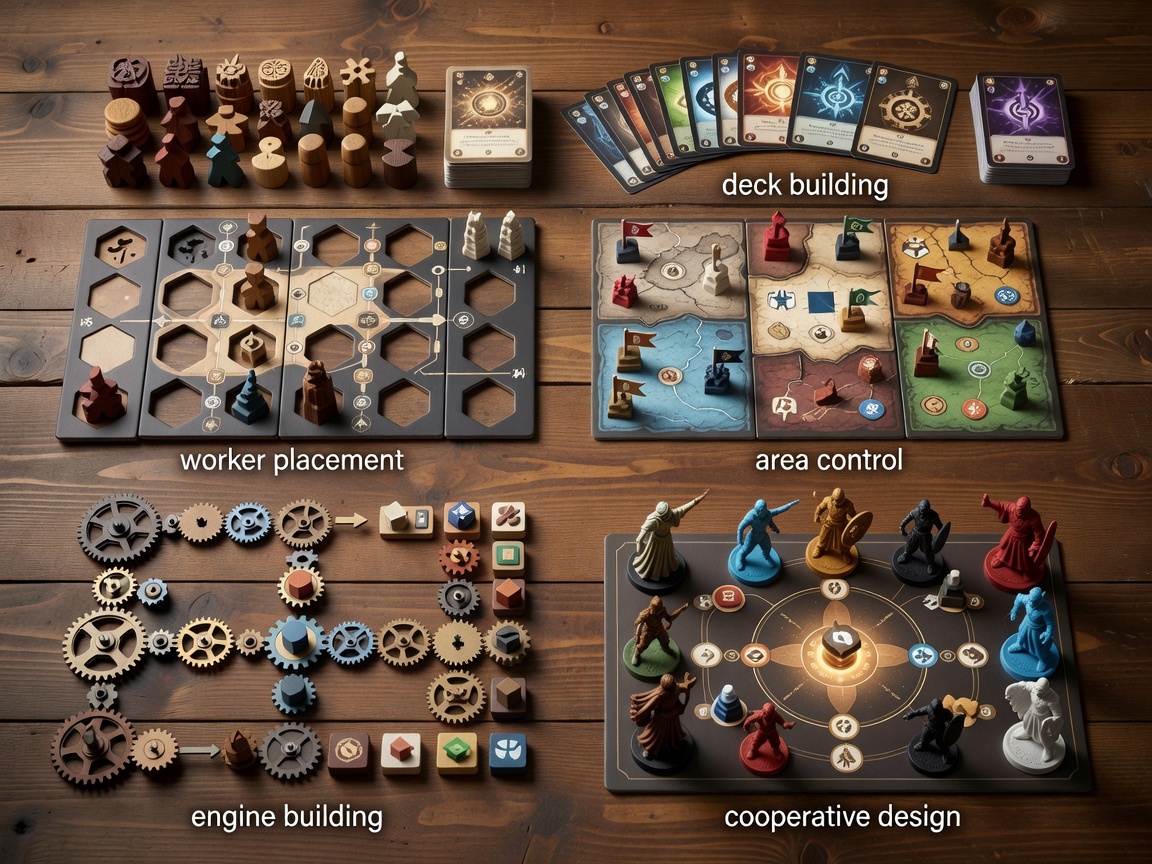
Read worker placementThis site looks at what worker placement, deck building, area control, engine building and cooperative design actually do at the table. The point is not to crown winners. It is to explain why these mechanisms feel different, where they overlap, and which published games make each one easiest to understand.
Why blocking matters, why action spaces create tension, and why Agricola, Caylus, Lords of Waterdeep and Viticulture explain the mechanism in different ways.
Read worker placementHow a weak starting deck turns into a tuned card economy, with Dominion, Star Realms, Clank! and Dune: Imperium showing the main branches.
Read deck buildingWhat makes map pressure meaningful, how timing beats raw expansion, and why Risk, El Grande, Inis and Root are not solving the same map problem.
Read area controlHow small efficiencies snowball into larger turns, and why Splendor, Wingspan, Terraforming Mars and Race for the Galaxy reward planning in very different rhythms.
Read engine buildingHow shared information, role powers and failure pressure interact, using Pandemic, The Crew, Spirit Island and Hanabi as especially clear reference points.
Read co-op designIf two games both say they are about building a city, surviving a crisis or controlling a region, that does not tell you much about how decisions are made. Mechanisms do. Worker placement is about contention over action spaces. Deck building is about changing your probability mix over time. Area control is about influence on a map and the timing of commitment. Engine building is about compounding effects. Cooperative design is about information management and collective planning under pressure.
Those labels are useful, but only up to a point. Many published games mix mechanisms freely. Dune: Imperium is not “just” deck building. It uses cards to place agents into contested spaces. Root is not merely area control either; faction asymmetry changes what presence on the map means from one side to another. The useful question is not whether a game belongs in exactly one box. It is which mechanism is doing the most explanatory work.