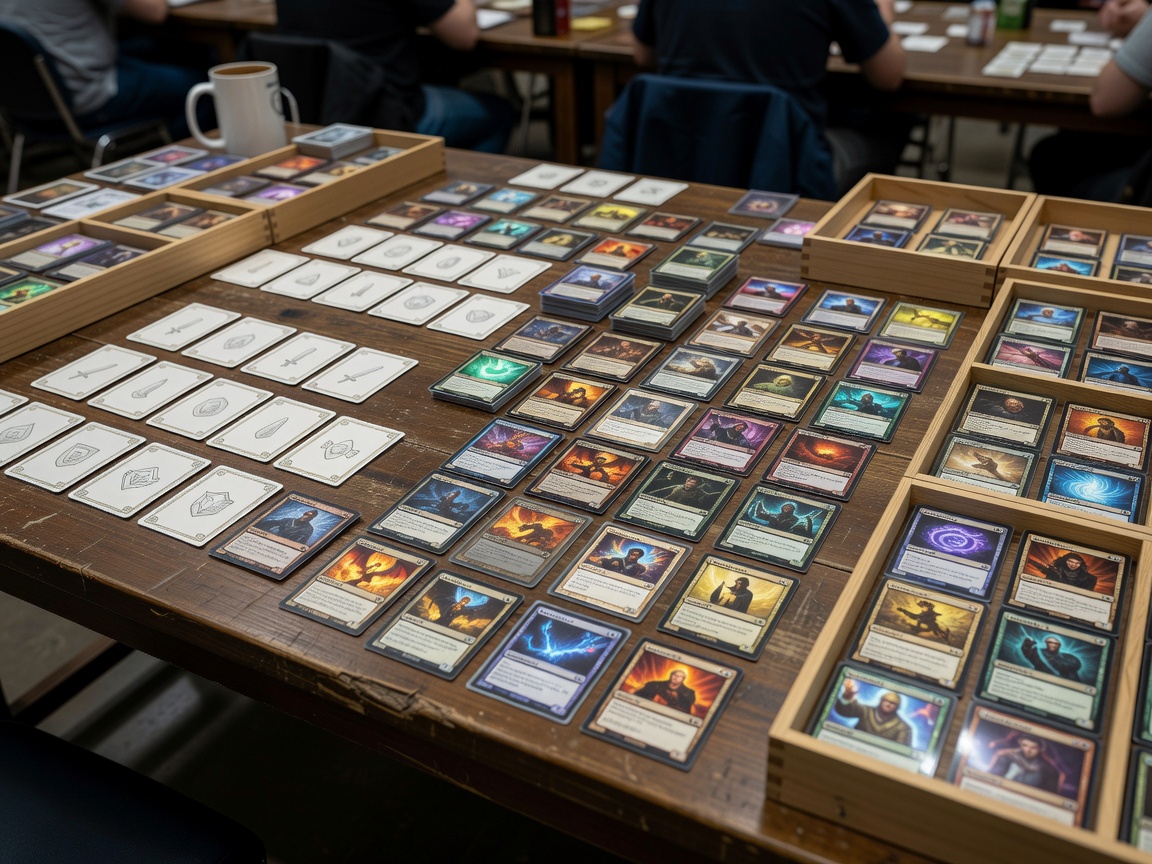
Deck building differs from collectible deck construction in one central way: the deck changes during play. You start weak, often with low-value currency and thin action options, then reshape the deck as the game unfolds. That means every purchase is doing two jobs at once. It provides a direct effect, and it alters the odds of what you will draw in later turns. The mechanism is therefore about tempo and composition as much as it is about raw power.
Dominion remains the clearest published starting point because it exposes those fundamentals with very little camouflage. Money buys cards. Action economy limits what can be chained. Victory cards clog the deck. Trash effects improve consistency. The famous lesson arrives quickly: more cards are not automatically better cards. A bloated deck can dilute the exact combinations you hoped to see. That principle has shaped almost every later design in the family.
Star Realms shows how deck building changes once cards have immediate tactical pressure. Instead of racing toward endgame points hidden inside your deck, you are dealing damage, setting up faction synergies and deciding whether short-term pressure is worth a less refined list. Because the market row is shared and public, denial matters more than in a static supply. If a card obviously completes an opponent’s faction chain, buying it away can be as relevant as buying it for your own plan.
Clank! demonstrates another branch: board movement grafted onto deck growth. Here the deck determines not just economy and attack, but mobility and noise. Cards contribute to risk on the map. The mechanism becomes spatial without ceasing to be probabilistic. That is useful because it shows how deck building can support adventure structure while still relying on the same old questions: should you clean the deck, buy points now or seek more efficient turns later?
Dune: Imperium is one of the strongest modern hybrid cases. Cards provide persuasion for purchases, but they also determine which board spaces your agents can access. This changes evaluation dramatically. A card may be mediocre as a reveal effect yet crucial as a placement permission. The deck stops being only an efficiency machine and becomes a map of future options. In other words, the mechanism is still deck building, but the reward for tuning the deck is not just “better hand quality.” It is access to a more valuable action network.
What deck building does well
The mechanism is excellent at giving players a sense of growth without requiring complicated bookkeeping. A new card enters the deck and the shape of future turns changes. That feedback loop is easy to teach and satisfying to feel. It also gives designers clean control over pacing. Early turns are modest. Mid-game turns become more expressive. Endgames often hinge on when to stop refining and start scoring.
Deck building also handles uncertainty in a readable way. Draw variance exists, but it is mostly self-authored. If your deck is inconsistent, the mechanism usually gives you a reason. That can make bad outcomes easier to accept, or at least easier to diagnose.
What separates strong examples from noisy ones
The key is whether card acquisition creates meaningful direction. In a strong design, you can explain why a card belongs in a deck beyond “it is good.” It enables a faction loop, compresses economy, accelerates cycling, supports a map plan or converts spare resources into points. In a weaker design, the market may simply be a pile of efficient effects that any player would be happy to take.
Another fault line is deck thinning. If the design includes ways to remove junk, then tempo, curation and opportunity cost become sharper. If it does not, the game may rely more heavily on sheer acquisition and market racing. Neither approach is wrong, but they produce different textures. Dominion makes trimming feel foundational. Clank! tolerates messier decks because the board gives those messy turns a context. Dune: Imperium lets some cards keep value through access icons even after their raw numbers fade.
Practical reading guide
- Start with Dominion for the basic grammar: buy, shuffle, draw, thin, score.
- Use Star Realms to see market denial and aggression accelerate the loop.
- Use Clank! to see deck quality tied to movement and risk.
- Use Dune: Imperium to see cards as permissions rather than only payloads.
If worker placement makes scarcity visible on the board, deck building makes probability visible in hindsight. You look at a great turn and can often trace it back several purchases. That delayed authorship is the mechanism’s real charm. It lets players feel clever now for choices they made earlier, when the payoff was not yet guaranteed.