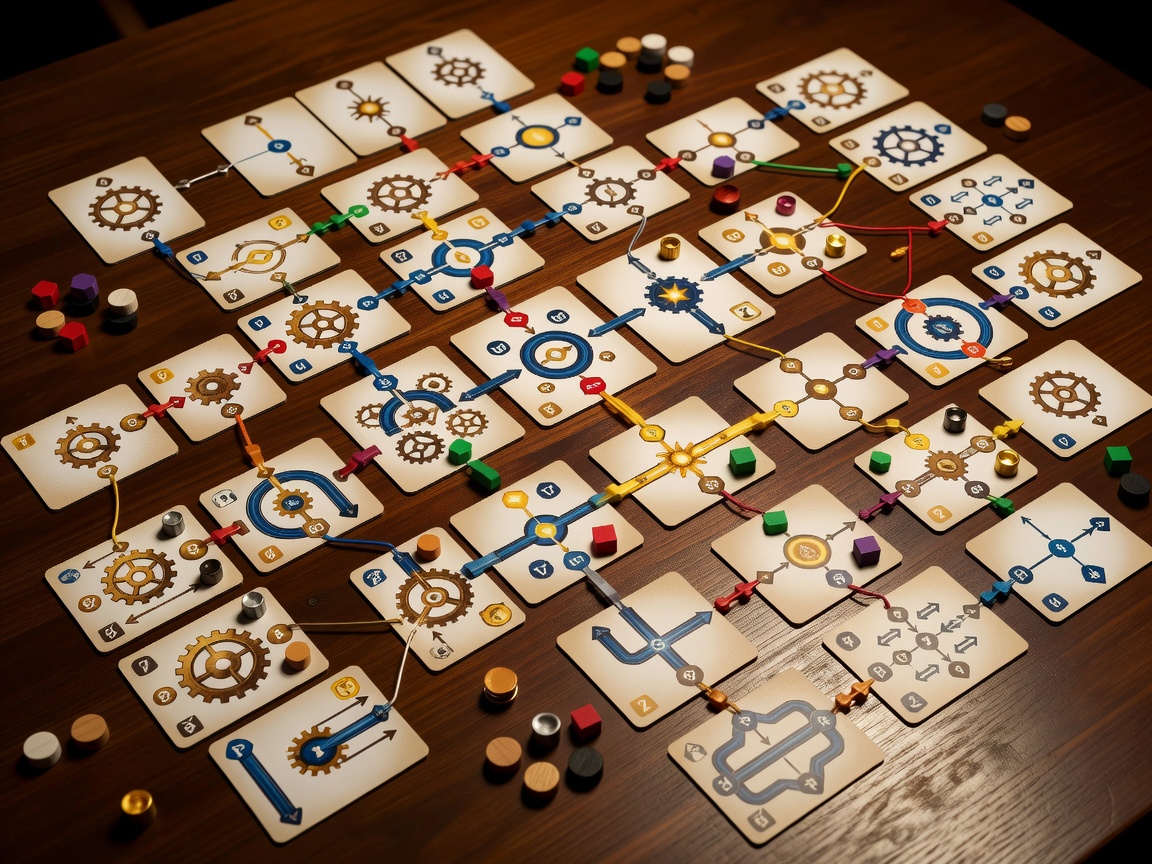
Engine building refers to a structure in which earlier investments improve the efficiency, volume or conversion power of later turns. The “engine” may be a tableau of cards, a network of production links, a row of permanent abilities or a collection of discounts and triggers. What matters is compounding. The design teaches you to accept weak turns now in exchange for stronger turns later.
Splendor is one of the purest introductions because its engine is almost stripped bare. Cards provide permanent gem discounts. Those discounts make later cards cheaper. Nobles reward card colour patterns. There is little rules noise between action and consequence. You can feel the acceleration in your hands: a purchase that once cost multiple chips becomes effortless because earlier cards quietly carry part of the burden. This is engine building at its most legible.
Wingspan adds activation rows and timing cadence. Birds sit in habitats, and each habitat becomes more productive as more birds are added. The engine is not just about cost reduction; it is about action compression. One activation can produce food, lay eggs and draw cards in linked sequence. That is why the mechanism feels satisfying even to players who are not usually drawn to optimisation. The turn literally gets fuller.
Terraforming Mars broadens the canvas. Here the engine may be economic, tag-driven, card-draw heavy, production based or tied to a narrow strategic axis such as microbes, Jovian cards or heat. This variety is part of its appeal, but it also makes it a less tidy teaching example than Splendor. You learn more about branching engine paths, less about the bare mechanics. Still, it is excellent for showing that an engine can be both powerful and fragile. Draw order, milestone races and map competition can reward an engine or leave it one turn short.
Race for the Galaxy is a sharper, denser case. Cards are worlds, developments, payment currency and scoring sources. The engine emerges from icon literacy and phase selection, not from a leisurely tableau. Because roles determine which phases resolve, your engine lives partly in predicting tempo. This is a good reminder that engine building need not be slow or sprawling. It can be brisk, compressed and slightly rude.
Why engines appeal
The mechanism gives players authorship over improvement. A stronger turn feels earned because it has been assembled. Unlike a pure event swing, a good engine advertises its parts on the table. Other players can see the pattern and either race, interfere or accept that they need a different scoring route. That visibility makes efficiency emotionally satisfying rather than arbitrary.
Engine building also produces a distinctive arc. Early turns are setup, mid-game is acceleration, and late game asks whether one more build step is worthwhile or whether it is time to convert everything into points. That last question is where many excellent designs live. The best engine is not always the one with the greatest output; sometimes it is the one that pivots to scoring soon enough.
Common design risks
If engines escalate without friction, the leader may become untouchable. If they never quite lift off, players can feel they spent the whole game priming machinery that never ran. Designers usually solve this by limiting actions, capping storage, introducing race conditions or making the end trigger independent of any one player’s comfort.
Another risk is false choice. When one upgrade path is broadly correct and the rest are scenic detours, the pleasure of building disappears. Strong examples usually support multiple lines that are context-sensitive rather than equally strong in all situations. Terraforming Mars is messy but rich partly because a card’s value depends on tag synergy, map position, production profile and pace to ending.
Published examples and their lessons
- Splendor teaches permanent discounts and elegant acceleration.
- Wingspan teaches row activation and action compression.
- Terraforming Mars teaches broad, branching engine identities with timing pressure.
- Race for the Galaxy teaches compact, tempo-sensitive tableau building.
A useful test: if your strongest turns would still be strong even without earlier setup, the design may be about tactical action selection rather than engine building.
Engine building often overlaps with deck building, tableau building and resource conversion, so the label can become blurry. The simplest way to keep it clear is to ask what improvement looks like. If the joy comes from seeing later turns do more because earlier turns installed capacity, you are in engine-building territory. It is the mechanism of delayed gratification, except the gratification usually arrives in a slightly absurd pile of extra actions and discounts.